
Web 2.0 is the business revolution in the computer industry caused by the move to the Internet as platform, and an attempt to understand the rules for success on that new platform.
—Tim O’Reilly.
In today’s post, I want to explore the importance of tone of voice for marketing on social media platforms. Social media is all about interaction, and is the catalyst for growing a community. Social media empowers users to consume and generate content such as text posts, comments, images, and videos and establishes a two-way flow of content creation and content consumption. I feel that community growth is healthy as these online interactions allows marketers to find unsolved needs which can then be addressed through product development and a marketing campaign.

Social media has a very extensive global reach. In a 2018 report, it was revealed that of the 7.593 billion people on Earth, 4.021 billion (a staggering 53%) are internet users. Of that 4.021 billion internet users, 3.196 billion are active social media users! This number of active social media users continues to increase, with a 362 million (13%) increase since January 2017. From my point of view, that is a huge audience and marketers can use social media as a powerful marketing tool.
But where does a marketer start out? In my opinion, the marketing focus should be on a geographical area, such as a region or a country. As I live in Singapore, it makes sense to analyze and discuss the statistics for social media usage in Singapore.
In January 2018, Singapore had a total population of 5.75 million people, with 4.83 million being internet users, and 4.80 million of them are active social media users. This means 97.4% of internet users in Singapore can be exposed to marketing campaigns made on social media platforms.
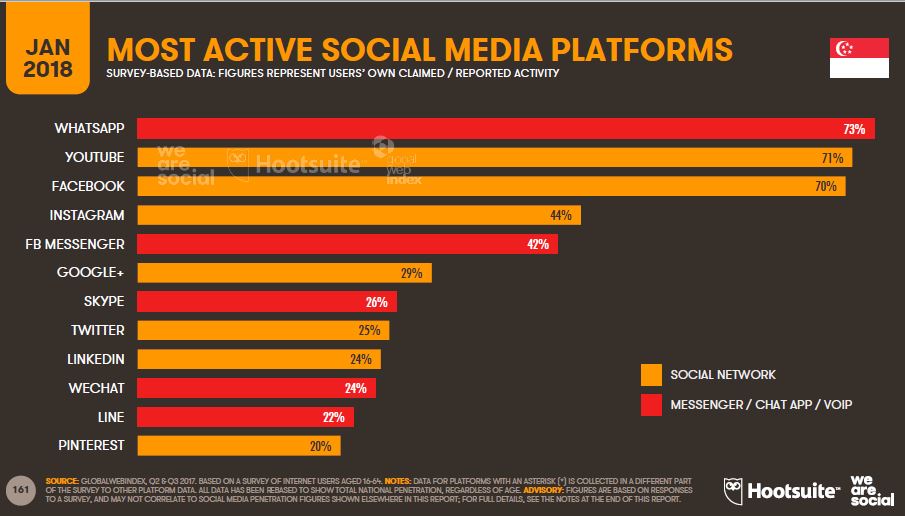
YouTube, Facebook and Instagram dominate the social media market in Singapore, with 3/4ths of the population active on both YouTube and Facebook, and almost half being active on Instagram. I feel that these social media platforms present the perfect opportunities for digital marketing. Brands are able to push related advertisements in the form of visual or text-based posts through matched AdSense or a similar algorithm onto their target audience.
But what happens when consumers begin to find advertisements to be out-of-touch or not relevant? Marketers must be careful to avoid these pitfalls to ensure that their marketing campaign is a success. The main aspect of social media is being relatable, therefore companies should aim to create a brand persona and use an appropriate tone of voice which customers can relate to and interact with through communication on the various social media platforms. After all, a warm and friendly brand persona is much more appealing than a cold and professional one.

Applying the appropriate tone of voice is critical when attempting to communicate with your target audience. An example of a catastrophic social media campaign was when DiGiorno, an American based frozen pizza brand, failed to research the context of the hashtag ‘#WhyIStayed’. The context of the hashtag was about women opening up about why they stayed in abusive relationships, while DiGiorno used it in a snarky/sassy context. The DiGiorno tweet resulted in a huge backlash, offending women who had been in abusive relationships before.
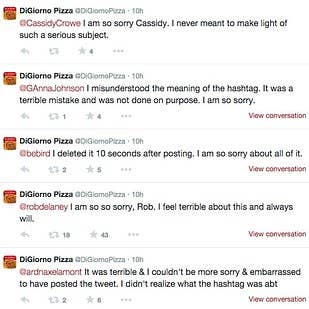
The failed DiGiorno Pizza digital marketing campaign shows us how important it is to use the correct tone of voice when designing marketing campaigns and interacting with customers on social media. Therefore, I feel that a social media PR person should be in charge of a brand’s social media platforms and give responses that are in-line and embody the brand’s stance and persona.
In conclusion, I feel that social media is advantageous to marketers as the desired target audience can be found easily and with an existing channel of communication between the brand and their customers. However, interaction has to be executed in a way that does not offend or insult the target audience.
Do you feel that tone of voice is important when it comes to communicating on social media platforms? If you were a marketing manager designing a marketing campaign for social media, what type of tone of voice would you use on your target audience, and why? Share your thoughts in the comments!
 Sher Min's Digital Marketing Blog

