
Featured

Web 2.0: How does Social Media And Tone of Voice Tie Into Digital Marketing?

Web 2.0 is the business revolution in the computer industry caused by the move to the Internet as platform, and an attempt to understand the rules for success on that new platform.

Tim O’Reilly.

In today’s post, I want to explore the importance of tone of voice for marketing on social media platforms. Social media is all about interaction, and is the catalyst for growing a community. Social media empowers users to consume and generate content such as text posts, comments, images, and videos and establishes a two-way flow of content creation and content consumption. I feel that community growth is healthy as these online interactions allows marketers to find unsolved needs which can then be addressed through product development and a marketing campaign.

Image credit: joe.ie

Social media has a very extensive global reach. In a 2018 report, it was revealed that of the 7.593 billion people on Earth, 4.021 billion (a staggering 53%) are internet users. Of that 4.021 billion internet users, 3.196 billion are active social media users! This number of active social media users continues to increase, with a 362 million (13%) increase since January 2017. From my point of view, that is a huge audience and marketers can use social media as a powerful marketing tool.

But where does a marketer start out? In my opinion, the marketing focus should be on a geographical area, such as a region or a country. As I live in Singapore, it makes sense to analyze and discuss the statistics for social media usage in Singapore.

In January 2018, Singapore had a total population of 5.75 million people, with 4.83 million being internet users, and 4.80 million of them are active social media users. This means 97.4% of internet users in Singapore can be exposed to marketing campaigns made on social media platforms.
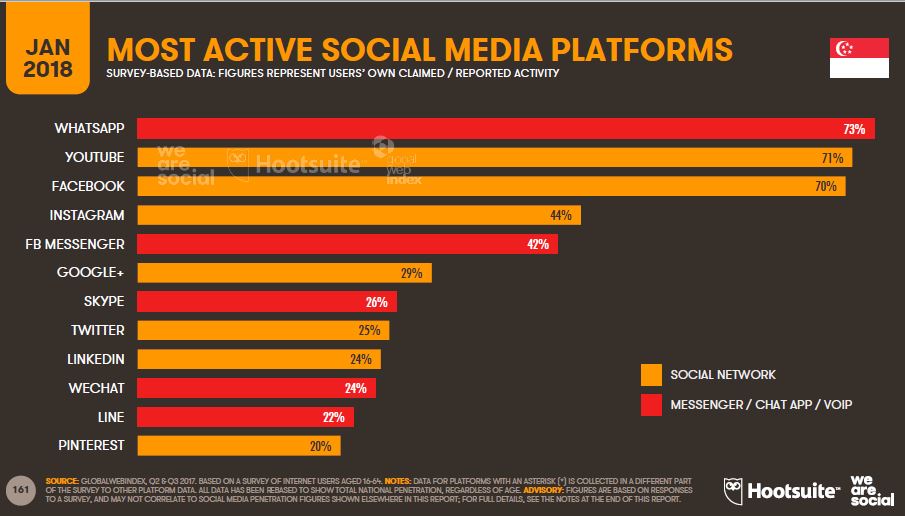
Image credit: wearesocial.com

YouTube, Facebook and Instagram dominate the social media market in Singapore, with 3/4ths of the population active on both YouTube and Facebook, and almost half being active on Instagram. I feel that these social media platforms present the perfect opportunities for digital marketing. Brands are able to push related advertisements in the form of visual or text-based posts through matched AdSense or a similar algorithm onto their target audience.

But what happens when consumers begin to find advertisements to be out-of-touch or not relevant? Marketers must be careful to avoid these pitfalls to ensure that their marketing campaign is a success. The main aspect of social media is being relatable, therefore companies should aim to create a brand persona and use an appropriate tone of voice which customers can relate to and interact with through communication on the various social media platforms. After all, a warm and friendly brand persona is much more appealing than a cold and professional one.

Image credit: BuzzFeed News

Applying the appropriate tone of voice is critical when attempting to communicate with your target audience. An example of a catastrophic social media campaign was when DiGiorno, an American based frozen pizza brand, failed to research the context of the hashtag ‘#WhyIStayed’. The context of the hashtag was about women opening up about why they stayed in abusive relationships, while DiGiorno used it in a snarky/sassy context. The DiGiorno tweet resulted in a huge backlash, offending women who had been in abusive relationships before.
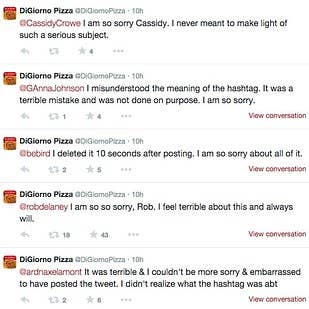
Image credit: BuzzFeed News

The failed DiGiorno Pizza digital marketing campaign shows us how important it is to use the correct tone of voice when designing marketing campaigns and interacting with customers on social media. Therefore, I feel that a social media PR person should be in charge of a brand’s social media platforms and give responses that are in-line and embody the brand’s stance and persona.

In conclusion, I feel that social media is advantageous to marketers as the desired target audience can be found easily and with an existing channel of communication between the brand and their customers. However, interaction has to be executed in a way that does not offend or insult the target audience.

Do you feel that tone of voice is important when it comes to communicating on social media platforms? If you were a marketing manager designing a marketing campaign for social media, what type of tone of voice would you use on your target audience, and why? Share your thoughts in the comments!
Search Engine Optimization and Paid Search Marketing: Cosmetics or Computers?

Google only loves you when everyone else loves you first.

Wendy Piersall

Have you ever gone past the first page of Google’s search results when you’re searching for something? Personally, I haven’t, and you may ask, why not? The answer to which is because what I’m looking for shows up on the first page of the search results. This is because Google’s mission is to organize and categorize information online and present it in such a way that the ‘best’ is at the top of the search results.

Google is by far the world’s most popular search engine, holding a whopping 92.2% of the worldwide search engine market share. With that being said, Google achieved this domination in the worldwide search engine market with a few core aspects such as local searches where proximity is matched to a user’s search intent where custom geo-proximity results made Google the go-to search engine for local searches, constantly testing and improving upon algorithms and AI to create better search results for consumers, and developing strong consumer trust through better results by providing better and more relevant results compared to Google’s competitors.

Image source: google.com

With Google being the most popular and most used search engine in the world, one must keep in mind that Google’s search engine provides is a service. Like with any top product or service, one of most important aspects that Google strives for is customer satisfaction and loyalty. As I previously mentioned, when using Google to search for something, I never really go past the first page of search results because what I search for is most often shown in the first page of the search results. This is due to Search Engine Optimization (SEO).

Image source: TRG

For a website to show up in Google’s search results, Google uses web crawlers to explore the internet to be automatically added into Google’s index. But to have that website show up on the first page of Google is a whole other story. Applying good SEO practices allows for a website to be one of the top results for particular searches. Typically, a search engine optimizer is hired to make certain changes to a website’s design and content that makes it more attractive to a search engine. SEO is a process that tweaks with factors such as content marketing which is the quality and relevance of content in regards to the particular search, on-page SEO which are elements that a website owner has complete control over such as title tags, meta descriptions, sub-headings and internal links, and lastly, off-page SEO which are elements that a website owner has no direct control over such as trust, links and social interactions.

Image source: Martechadvisor.com

An example of well implemented search engine optimization is MAC Cosmetics versus Apple’s Mac (Macontish) product family. One critical aspect of SEO is the usage of negative keywords, with the usage of negative keywords. Negative keywords ensure that ads for your website are only generated for specific audiences. The name ‘Mac’ as a brand can refer to Apple’s Macintosh or MAC cosmetics, the same name for two different brands in two very different industries. When searching for ‘mac’, both MAC Cosmetics and Apple’s Mac appeared as ads. However, when searching for ‘mac computer’, everything related to MAC Cosmetics disappeared because it was no longer relevant. This is due to MAC Cosmetics likely having ‘computer’ and other similar words on their negative keywords list. In my opinion, negative keywords helps marketers focus on their target market and makes their marketing campaigns meaningful by using negative keywords as a filter or method of separating themselves from the searches for their competitors.

Do you feel that SEO is an important aspect for marketers to pay attention to when designing websites for a brand? Should marketers craft advertisements in SEO in mind for relevant brand campaigns? How else can marketers and companies use SEO to their advantage? Share your thoughts in the comments!

The Internet of Things and Big Data: How Google is Making Homes Smart

 The truth is, homes change over time — and technology has to adapt, not try to do everything at once.

Tony Fadell

The phrase ‘the Internet of Things’ can really be applied to any household item now. With almost any machine that can be connected to the internet such as fridges that can stream Spotify and QR-scanning juice machines, one starts to wonder if these ‘smart’ wifi-enabled machines are really needed.

When I think of ‘smart’ devices, the first thing that comes into mind is my smartphone; the Google Pixel 3. After previously being an iPhone user, I made the switch to Google’s Pixel smartphone due to the rich ‘Internet of Things’ ecosystem that Google has created that trumps Apple’s existing ecosystem. The Google ecosystem includes all of Google’s apps and programs (Google search engine, Gmail, Google Docs, Google Calendar, etc) and electronic products such as smart speakers, smart displays, and smoke detectors.

Image source: Electronic House

Google’s extensive program and device ecosystem, facilitated with Google’s AI, Google Assistant, makes Google a very lucrative ecosystem to outfit a smart home with. Personally, I too agree with this statement as a user of Google’s ecosystem and having a friend who uses Google’s ecosystem and products extensively, it is not hard to see why Google’s smart home functionality is top tier due to its IoT integration. Google Assistant delivers a near-flawless experience in terms of convenience, accessibility and integration. With the AI being able to perform a myriad of tasks from setting alarms and reminders to more impressive functionalities such as; live conversational interpretations and flight check-ins, I feel that Google has truly created a unique smart ecosystem of ‘internet of things’ facilitated by its AI.

Image source: Medium

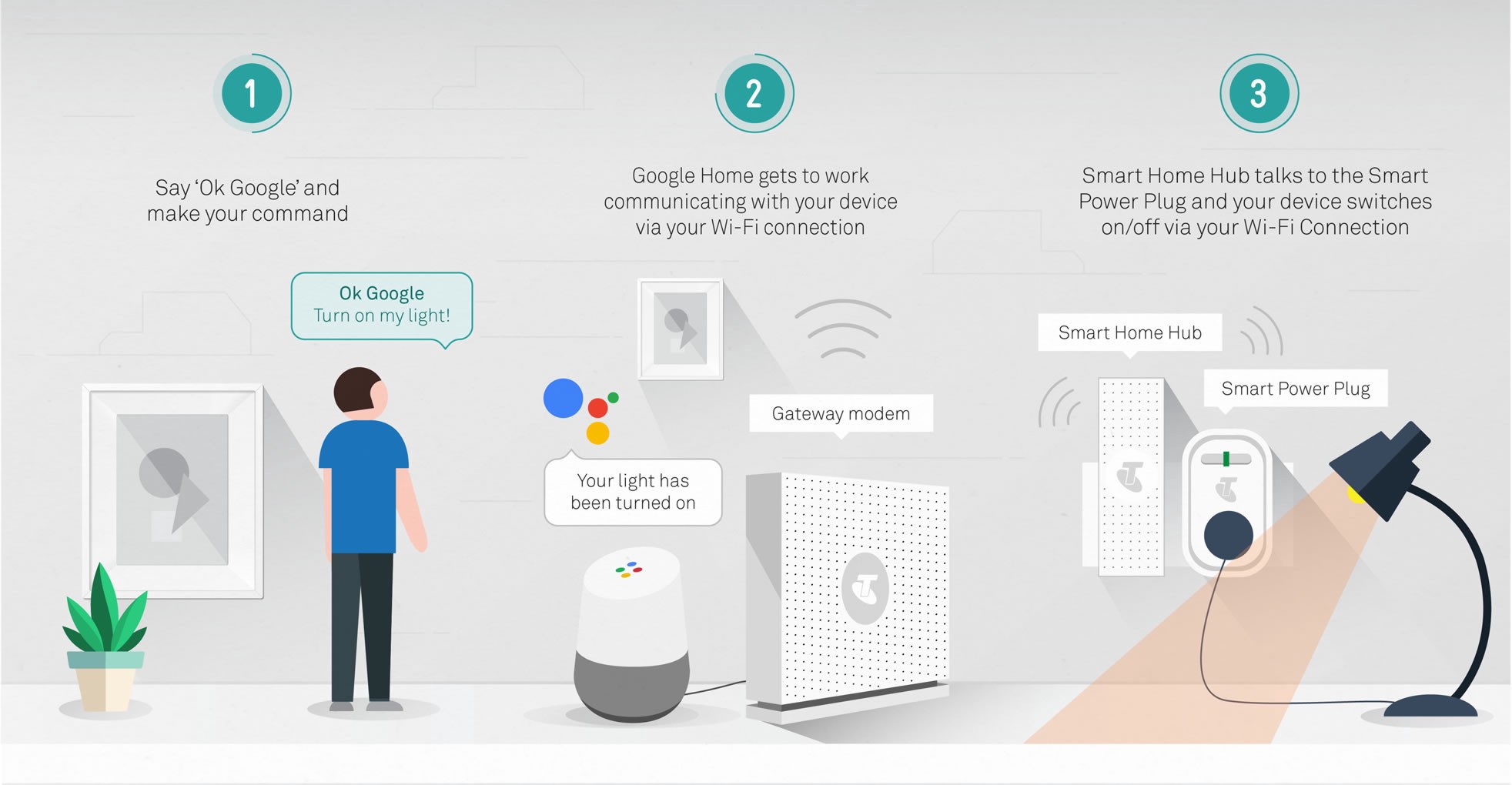
So why and how does the Internet of Things concept play such a huge part in creating a smart home ecosystem? Having an IoT device allows for a two way flow of data between the IoT device and Google Assistant AI, enabling a feedback loop where outputs of a system are routed back as inputs. What makes Google Assistant an extremely strong competitor in the smart home market is mainly due to Google’s excellent voice recognition software. I feel that using speech as communication medium is arguably the most sensible form of communication due to the ease and clarity that verbal cues and conversations embody when carrying out day-to-day tasks. There is something very satisfying behind the simplicity of being able to say ‘Ok Google, set an alarm for 7:30am tomorrow’, and having it synced up to your Google Home smart speaker as compared to manually scrolling and tapping through your phone’s alarm function or fiddling with buttons on an alarm clock just to set an alarm.

Having a smart home is becoming a norm rather than remaining as a trend with the increasing availability of IoT devices. This is due to the rich value that a smart home possesses; increasing our quality of life. Personally, I feel that having a ‘smart’ home would be advantageous due to increased automation and monitoring of device usage would help in increasing my productivity and optimizing my electricity usage. In addition to improving a inhabitant’s quality of life, from a marketing perspective, it creates another interesting perspective which is the potential increase in value in homes which are outfitted with IoT devices and integrated into a smart device ecosystem.

Image source: bigcommerce.com

With Google becoming the choice ecosystem for a smart home, this makes it a very lucrative position for Google to be in due to the collection of big data from their vast network of individual ecosystems. Big data, such as consumers’ music preferences, online shopping orders, and even sleep habits, which are passively gathered can be analyzed and used to deliver custom-tailored advertisements to their consumers. I feel that this is a strategic marketing move as this allows Google to tap into a huge market which has been pre-segmented based on big data analysis, allowing specific advertisements to reach their targeted audience.

While smart home integration still has a long way to go before it becomes a staple to have an smart, IoT device ecosystem in homes, do you feel feel that the IoT device ecosystem is heading in the right direction? How else can ecosystems, the collection and analysis of big data benefit marketers? Share your thoughts in the comments!

Mobile Marketing: How WeChat is the Swiss Army Knife of Mobile Phone Apps in China

If your plans don’t include mobile, your plans are not finished.

Wendy Clark

In this day and age, it would be hard to find a Millennial or Gen Z who does not own a smart device. In fact, there are over 2.7 billion smartphone users and 1.35 billion tablet users across the world. Like it or not, mobile apps have become part of our life, with the average person using around 25 apps per month, with a large majority of their time split between 10 apps.

When I think of apps, the first things that comes to my mind is utility, health, information/educational, convenience, shopping, messaging, social media, and entertainment. With an almost endless selection of apps available for download through the mobile app giants, Apple’s iOS App Store and Android’s Google Play Store, there is definitely revenue being generated especially with hybrid monetization models such as in-app ads and in-app purchases. I feel that mobile apps are a promising area that marketers should tap on to generate higher interest and profits.

There are many kinds of apps, with most of them filling one primary purpose. Examples would be entertainment apps such as Netflix and Minecraft Pocket Edition; both fulfill their primary purposes of providing streaming content and a video game experience respectively. Messenger apps such as WhatsApp, Facebook Messenger and Telegram provide the primary purpose of communication through instant messaging, chat groups, and media sharing. Personally, I feel that with each individual app fulfilling a single purpose poses a problem of bloating; there comes a point where consumers would be overwhelmed with the sheer number of apps installed on their devices. While I feel that this allows for a higher count of in-app advertisements and other marketing strategies across a variety of apps.

WeChat is a Chinese multi-purpose messaging, social media and mobile payment app developed by Tencent, a Chinese multinational conglomerate. WeChat addresses the app bloat issue by being a multipurpose app and has been described as China’s “app for everything” and a “super app” due to its wide range of functions. WeChat fulfills multiple purposes, such as messaging, media sharing, digital payment services, navigation, booking of services (such as movie tickets, flight and rail tickets, ride hailing), buying and rental of property, contacting customer support, among other features. With a user base of over 1 billion users, I feel that WeChat is a very lucrative marketing channel for companies in China, due to the Great Firewall of China blocking other social media platforms such as Facebook.

However, in reality, I believe it would be impossible to create a super app in the likes of WeChat outside China as most apps have high switching costs for consumers. The need to create a new account, re-fill out personal information and tweak settings may prove too daunting and troublesome for most consumers. I feel that a more realistic solution would be for large companies, to acquire smaller companies and in turn, obtain their mobile apps. An example of this would be Facebook acquiring 2 popular social media apps; Instagram and Whatsapp, and rebranding them as belonging under the Facebook umbrella.

With the acquisition of Instagram and WhatsApp, Facebook has potentially redefined how billions of people use these apps to connect with one another inside the company’s ecosystem of apps. A good example would be the possible reduction of competition from rival messaging services, like those offered by Apple and Google. In my opinion, I feel that Facebook might also be able to increase its advertising business or add new revenue-generating services if users interact more frequently with Facebook’s apps, generating greater profits. Mark Zuckerberg believes in integrating the services of WhatsApp and Instagram will benefit the Facebook ‘family of apps’.

While the ‘swiss army knife’ of apps that is WeChat may not be achievable outside of China, do you feel that Facebook is taking the right steps to achieving an app coverage that may be comparable to WeChat, in terms of social media functions in the future? Do you feel that other large companies with the capacity to acquire similar companies with similar app functions may follow the Facebook route in the near future? As marketing students, do you feel that that in-app advertisements and other app-related marketing strategies may be easier to implement to yield greater exposure and profitability in a mega-app such as WeChat? Share your thoughts in the comments!
Virality and Memes: How Disney’s Baby Yoda Achieved Overnight Meme-Stardom

Going viral isn’t random, magic, or luck. It’s a science.

Jonah Berger

At some point, we’ve indulged ourselves by browsing memes or have seen how things posted on the internet become viral overnight. I feel that this aspect of virality has only become more potent with the dawn of social media, where things such as images, videos, people, topics, and items can take up the front stage of social media overnight.

One of the most popular topics that went viral last year was the ‘Storm Area 51, They Can’t Stop All of Us’ event made on Facebook, which spawned forth many memes and merchandise that were then shared and sold through Facebook and on other social media platforms.

When I think of virality, the first thing that comes to mind is how fast something can proliferate onto almost every social media platform, and even mainstream media. Sometimes, virality is engineered whereas sometimes virality can come as a surprise. I feel that as a marketer, the concept of virality can be used as a powerful marketing tool to create buzz and demand for a certain product or service. In addition to virality, I feel that ‘mainstream’ memes are also intrinsically tied to virality. For a meme to become mainstream, it must first fulfill the aspects of virality.

In my opinion, an individual is more likely to share content (for it to gain traction and become viral) if it is something; that they can relate to, evokes positive emotions (amusement, happiness, excitement, surprise), and has novelty (new or unusual). This is where social media plays an important part in virality, as a tool to help the spread of content. Therefore, the perfect combination of memes and virality through social media can yield some very promising and profitable results for a marketer.

Meet Baby Yoda, the breakout character and meme took the Internet by storm at the end of 2019. The character appears in Disney’s newest Star Wars web television series, streamed exclusively through Disney+ (Disney’s streaming service), The Mandalorian. Officially, the character is named ‘The Child’, however he has been nicknamed by both fans and media alike as ‘Baby Yoda’. Baby Yoda has been attributed as one of the key parts in the success of The Mandalorian and Disney+, and has also been quickly cemented as a lovable character in pop culture and memes, having 2.28 million tweets featuring the words ‘Baby Yoda’ between 12 November and 5 December in 2019.

However, Baby Yoda’s success was not anticipated by the directors and marketing team of Disney’s The Mandalorian as the character was kept a secret and was only officially addressed on social media a week after the series debut, to avoid any spoilers regarding the reveal of the character. The directors had wanted Baby Yoda to be a surprise to viewers, however Baby Yoda’s fame has eclipsed that of his franchise. Disney’s marketing team was taken aback by the overnight fame of Baby Yoda, and was not prepared for the market demand for Baby Yoda themed merchandise. Due to the secrecy surrounding Baby Yoda as a character, products themed after the character were withheld months before the release of the series.

I feel that Disney’s marketing team, despite knowing the success and revenue Baby Yoda would bring them, should had not withheld producing Baby Yoda merchandise. A huge opportunity was lost due to the massive demand for Baby Yoda merchandise for Christmas 2019. In addition, it has been estimated that Disney lost around $2.7 million USD in revenue the delayed release of merchandise. Due to the scarcity of Baby Yoda merchandise in 2019, many unlicensed products were created and sold online, prompting Disney to issue many takedown notices due to copyright violations. As a marketing student, I felt that Disney should had taken the viral potential of Baby Yoda and make a strategic marketing move to secure greater revenue by releasing official Baby Yoda merchandise in sync with the launch of the Mandalorian.

With the high penetration of memes and virality through social media platforms, do you feel that memes can benefit marketers and companies? How else can marketers use memes to appeal to masses by being something that they can relate to, invokes positive emotions, and posses some quality of novelty? As social media is here to stay, do you feel that marketers should take virality seriously? Share your thoughts in the comments!

Social Media and Business Models: Morality and Ethics in Crowdfunding

The unique value of crowdfounding is not money, it’s community

Ethan Mollick

In today’s post, I will share my thoughts on how morality and ethics play a role in crowdfunding. When I think of crowdfunding, I think of how the collective effort of thousands of people can make a dream or a concept come true. Unlike other business models where the company seeks support in the form of money through loans and investments, I feel that crowdfunding has a more intimate and personal connection as each individual crowdfunder has a stake in a crowdfunding business model.

Unlike traditional businesses where a investor or loan contributes a significant amount of capital to kick-start a project, crowdfunding, as the name implies, relies on a large number of individuals, contributing anywhere from a few to a hundred dollars, depending on how invested the individual is. In my opinion, this flexibility for contributions can help a business identify who their primary persona is when building their branding through crowdfunding. This primary persona can be identified through the usage of machine-learning social media analysis on publicly available information from crowdfunders, building a representative image of what a business’s target audience persona will be.

I feel that social media and crowdfunding are closely intertwined with each other. In order to find individuals who would want to contribute to your business project, one turns to social media to find people. This is due to the immense networking capabilities and easy accessibility that social media possesses. In turn, social media helps to expand that pool of contributors through ways such as sharing and word-of-mouth.

While the prospects of crowdfunding sound very attractive to both consumers (the backers who donate funds to business projects they are interested in and want to support) and businesses (who are able to secure funding from a vast audience), I would like to address how morality and ethics play a part in getting funds.
Crowdfunding projects can be misleading, and sometimes straight out scams for backers (the crowdfunders). One such example is the Triton scuba mask, touted by its creators as the ‘World’s First Artificial Gills Re-breather’ that appeared on the Indiegogo, a crowdfunding platform in 2016.

Image credit: snopes.com

The Trition claimed to allow people to breath underwater for extended periods of time (up to 45 minutes). This would be achieved by the two branching arms that functioned as ‘gills’ which would extract oxygen from the surrounding water to deliver breathable air to the user. The appeal behind the Trition was having a minimalist scuba gear setup as compared to the bulky equipment used by all scuba divers.

The Triton Indiegogo campaign gained over $100,000 of funding from backers in just over 24 hours from launch, and gained nearly $900,000 of funding at the end of the campaign. However, many began to point out the scientific flaws of the Triton as it was just not technically nor scientifically feasible for the product to work. The crowdfunding campaign for the Triton was canceled and campaign backers were refunded due to misleading information of the product’s claims. The Triton was then brought back onto Indiegogo with updated information and disclosed the use of ‘liquid oxygen’ cylinders which would provide the user with oxygen.

While crowdfunding can bring projects from a developmental stage to a fully realized product with the wallets of individuals., I believe that companies and businesses who opt to secure funding through this route must be ethical and moral and should not market ideas that are not feasible or are scams. As majority of a crowdfunder’s backers find these crowdfunding projects through social media, I feel that crowdfunding campaigns should take on the responsibility of presenting the information and concept the project in an educational way to show backers how their funds will be used to make the project a reality.

What stance would you take if you were a marketing manager and your company wanted you to be unethical and immoral when marketing a new product? Would you support this decision or be against it, and why? Share your thoughts in the comments!

Design a site like this with WordPress.com
Get started